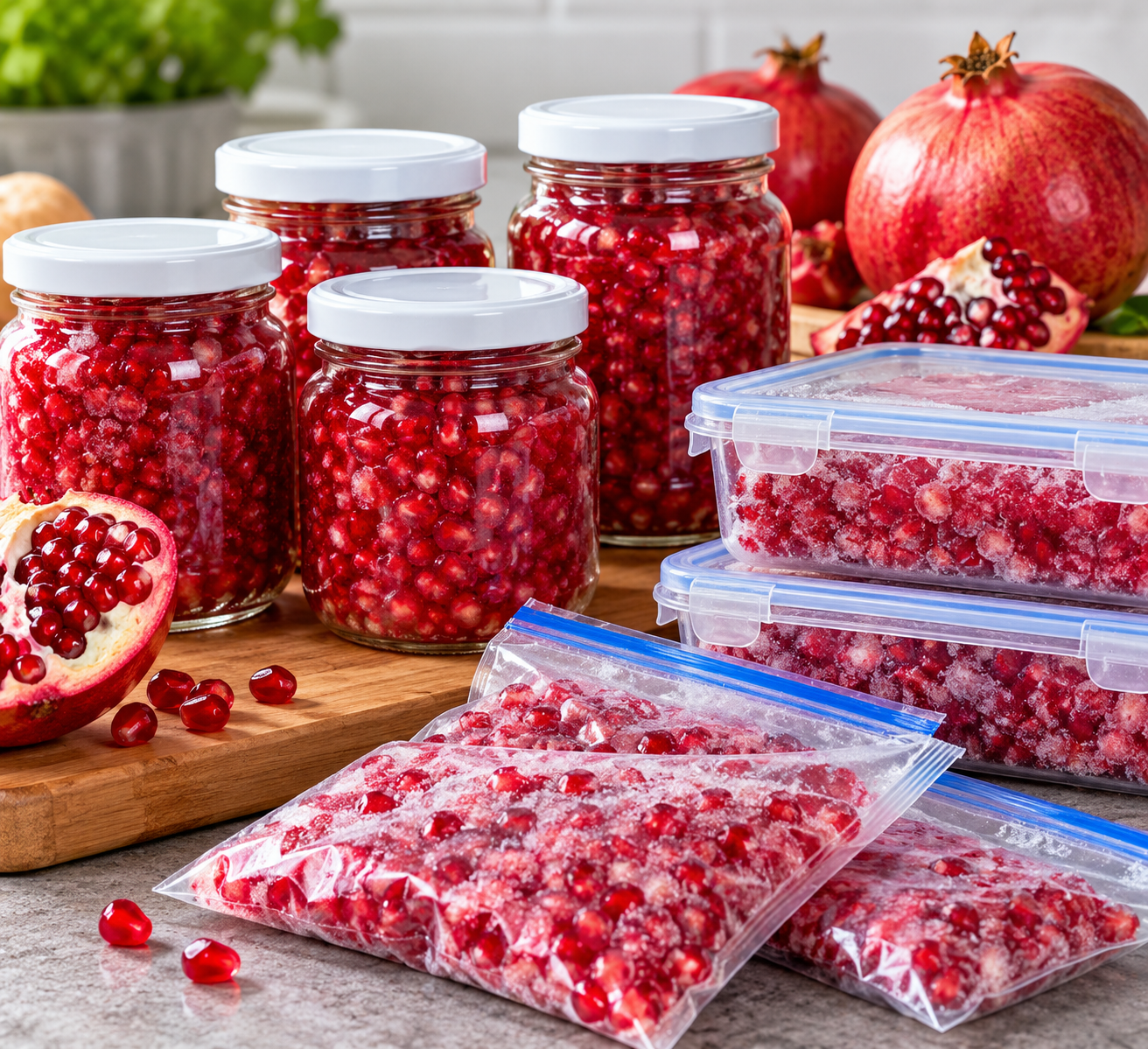
How to Preserve Pomegranates: Freezing, Storage, and Syrup Tips
Fresh pomegranates are prized for their juicy, ruby-red seeds and pleasantly sweet-tart flavor. However, once the fruit is opened, its edible seeds can lose freshness relatively quickly if stored incorrectly.
Fortunately, proper freezing and careful juice storage can help you enjoy pomegranates long after their peak season. Whether you want to save individual seeds for smoothies, preserve fresh juice, or keep homemade pomegranate syrup, understanding the right storage techniques can help maintain flavor, reduce food waste, and prevent spoilage.
Practical Cooking Tips for Preserving Pomegranates
1. Choose Fresh, Firm Pomegranates Before Storage
Successful preservation begins with selecting good-quality fruit.
Look for pomegranates that feel heavy for their size, have firm skin, and show no signs of mold, leaking juice, or significant damage.
The fruit’s exterior color can vary depending on the variety, so a darker red appearance does not necessarily indicate better quality.
For the best storage results:
- Choose fruits with firm, intact skins.
- Avoid pomegranates with soft, moldy, or leaking areas.
- Select heavy fruits that feel full of juice.
- Handle the fruit carefully to prevent unnecessary bruising.
- Refrigerate whole pomegranates if you do not plan to use them soon.
Preserving fruit while it is still in good condition helps maintain better flavor and texture. Freezing will not reverse spoilage that has already started.
2. Remove Pomegranate Seeds Without Crushing Them
The edible, juice-filled portions of a pomegranate are called arils. Each aril surrounds a small seed.
Removing them gently helps preserve their appearance and prevents unnecessary juice loss.
One useful technique involves scoring the outer skin along its natural sections and carefully pulling the fruit apart.
You can then loosen the arils with your fingers over a bowl.
For easier separation, work in a bowl of clean, cold water. The heavier arils generally sink, while much of the white membrane floats.
This approach offers several advantages:
- Reduces juice splattering around the kitchen.
- Makes removing bitter white membranes easier.
- Helps keep individual arils intact.
- Simplifies preparation when handling several fruits.
After separating the arils, remove any remaining membrane and drain them thoroughly.
Avoid crushing the arils if you intend to freeze them whole.
3. Dry Pomegranate Arils Before Freezing
Excess surface moisture can cause pomegranate arils to freeze together in large clusters.
After removing them from the fruit, place the drained arils on clean paper towels or a clean kitchen towel.
Gently pat away visible water without applying enough pressure to burst the juicy sacs.
The goal is to remove surface moisture rather than dry out the fruit itself.
This small preparation step helps the arils freeze more individually, making them easier to portion later.
It is particularly useful when you want to remove only a small amount from the freezer for garnishes, smoothies, or other dishes.
4. Freeze Pomegranate Arils in a Single Layer
Freezing is one of the most practical ways to preserve pomegranate arils for extended periods.
For better results, spread the dry arils across a freezer-safe tray lined with parchment paper.
Keep them in a single layer with minimal overlap.
Place the tray in the freezer until the arils are completely firm. Depending on your freezer and the amount of fruit, this may take a few hours.
Once frozen, transfer them promptly into freezer-grade bags or airtight, freezer-safe containers.
For efficient freezer storage:
- Remove excess air from freezer bags before sealing.
- Divide large quantities into smaller portions.
- Label each package with the freezing date.
- Keep the packages away from frequent temperature fluctuations.
- Avoid repeatedly thawing and refreezing the same portion.
According to the University of California Master Food Preserver Program, properly packaged frozen pomegranate arils can be stored for up to one year.
This is a practical quality guideline rather than a guarantee that the fruit will retain its original texture throughout storage.
5. Freeze Fresh Pomegranate Juice Separately
Freezing pomegranate juice is another useful option, especially when you have more fruit than you can comfortably use fresh.
When extracting juice, avoid excessive crushing of the hard inner seeds and bitter membranes.
A short pulse in a blender can help release the juice from the arils. Straining afterward separates the liquid from most of the solids.
For freezer storage, use containers specifically designed for freezing liquids.
Leave appropriate empty space at the top because juice expands as it freezes.
Avoid filling glass containers completely, as expansion can cause breakage.
Smaller portions are especially convenient because you can thaw only the amount needed.
Freezing is generally preferable to prolonged room-temperature storage and helps preserve the juice’s characteristic color and flavor.
6. Treat Homemade Pomegranate Syrup as a Refrigerated Product
Homemade pomegranate syrup can add concentrated fruit flavor to beverages, desserts, dressings, and sauces.
However, an important distinction exists between preparing a sweet syrup and making a shelf-stable preserved product.
Adding sugar and heating pomegranate juice does not automatically make homemade syrup safe for long-term storage at room temperature.
The amount of sugar, acidity, preparation method, and storage conditions all influence its keeping quality.
Utah State University Extension provides guidance for homemade grenadine-style pomegranate syrup and recommends refrigerated storage for one to two weeks, or freezer storage for longer preservation.
For safe handling:
- Use clean utensils and food-safe containers.
- Refrigerate syrup promptly after preparation and cooling.
- Keep containers tightly covered.
- Use clean utensils when dispensing syrup.
- Freeze portions that will not be used during the recommended refrigerated period.
Do not assume that sealing warm syrup inside a glass bottle makes it shelf-stable.
Long-term pantry storage requires an appropriate, scientifically tested preservation process for the exact product.
7. Label and Organize Your Preserved Pomegranates
Good freezer organization makes preserved fruit easier to use and helps reduce forgotten packages.
Write the contents and freezing date on each bag or container.
If you freeze both whole arils and juice, keep them in separate, clearly labeled packages.
Consider storing smaller quantities toward the front of the freezer so they are easier to access.
Use older packages before newer ones to help maintain a simple first-in, first-out rotation.
This approach makes it easier to monitor quality and avoid keeping frozen ingredients longer than intended.
Why These Pomegranate Preservation Tips Work
Understanding a few basic food-storage principles can help explain why certain methods produce better results.
Freezing Slows Deterioration
Low temperatures greatly slow the activity of microorganisms and the changes that contribute to food spoilage.
When food remains continuously frozen at 0°F (-18°C) or below, microbial growth is effectively halted, although freezing does not reliably kill all harmful microorganisms.
This is why proper food handling before freezing remains essential.
Over time, frozen fruit may still experience changes in flavor, color, and texture.
Surface Moisture Encourages Clumping
When wet arils are placed together in the freezer, surface water can form ice that connects neighboring pieces.
Drying the arils and freezing them separately reduces this problem.
Once the arils are frozen individually, they can be combined in a storage bag without becoming as firmly stuck together.
Airtight Packaging Protects Quality
Exposure to air in the freezer can contribute to dehydration and freezer burn.
Freezer burn affects the appearance, texture, and flavor of frozen food, although it does not automatically make the food unsafe.
Using freezer-grade packaging and removing excess air helps limit moisture loss.
Sugar Alone Does Not Ensure Safe Preservation
Sugar can influence the amount of water available for microbial growth, but its effectiveness depends on the final concentration and the characteristics of the food.
A homemade pomegranate syrup prepared with an arbitrary amount of sugar should not be treated as a reliably shelf-stable product.
Refrigeration or freezing remains the safer approach unless a properly tested canning procedure is followed.
Common Mistakes to Avoid
Even simple preservation methods can produce disappointing results when important details are overlooked.
1. Freezing arils while they are wet
Excess water can create ice buildup and cause individual arils to stick together.
Better approach: Drain and gently dry the fruit before arranging it on a freezing tray.
2. Putting all the arils directly into one large bag
Fresh arils packed closely together may freeze into a solid mass.
Better approach: Freeze them separately on a tray before transferring them to storage packaging.
3. Using unsuitable freezer containers
Thin packaging or loosely covered containers may expose fruit to air and moisture loss.
Better approach: Choose freezer-safe bags or containers that provide an effective seal.
4. Expecting thawed arils to remain perfectly crisp
Freezing changes the structure of the fruit’s cells. As the arils thaw, they can release juice and become softer.
Better approach: Use thawed arils in applications where a softer texture will not be noticeable.
5. Storing homemade syrup in a cupboard
A sweet flavor and tightly closed bottle are not evidence that a syrup is safe for room-temperature storage.
Better approach: Keep homemade syrup refrigerated for the recommended period or freeze it.
6. Ignoring unpleasant odors or visible spoilage
Mold, unusual fermentation, or an off odor may indicate that a product should no longer be consumed.
Better approach: Discard suspicious products rather than tasting them to determine whether they are safe.
Practical Kitchen Examples
These everyday situations demonstrate how proper pomegranate preservation can make food preparation more convenient.
Keeping Pomegranate Arils Available for Breakfast
If you regularly add pomegranate arils to yogurt, oatmeal, or breakfast bowls, freezing individual portions can simplify your routine.
Take a small amount from the freezer when needed.
For dishes where a fresh, firm texture matters, use newly opened refrigerated arils instead of fully thawed ones.
Frozen arils tend to work particularly well when mixed into foods where some softening is acceptable.
Saving Extra Pomegranates for Smoothies
When several ripe pomegranates need to be used, freezing the arils can prevent unnecessary waste.
For a smoothie, frozen arils can go directly into the blender without thawing first, provided the blender is suitable for frozen ingredients.
This also helps keep the drink cold.
Keeping Pomegranate Juice for Cooking
Small frozen portions of pomegranate juice are useful when you need a little tart fruit flavor for a sauce, dressing, or beverage.
Freeze juice in suitable small containers or freezer trays, then store the frozen portions in appropriate sealed packaging.
Thaw the amount needed in the refrigerator.
Managing Leftover Pomegranate Syrup
If you have homemade pomegranate syrup that you are unlikely to use within the recommended refrigerated storage period, freezing the extra syrup is a better choice than leaving it in the refrigerator indefinitely.
Use small, freezer-safe containers and allow space for expansion.
This makes the syrup easier to portion while avoiding unnecessary storage at room temperature.
Extra Kitchen Tips for Better Results
Protect Kitchen Surfaces From Stains
Pomegranate juice contains strongly colored pigments that can stain clothing, countertops, and certain kitchen materials.
Prepare the fruit over a large bowl, use a stable cutting board, and wipe up spills promptly.
An apron can also be helpful when handling several pomegranates.
Choose the Right Form for Your Intended Use
Whole arils, juice, and syrup serve different purposes.
- Frozen arils: Useful for smoothies, mixed fruit dishes, and garnishes where a softer texture is acceptable.
- Frozen juice: Convenient for sauces, dressings, and beverages.
- Refrigerated syrup: Suitable for adding concentrated sweet-tart flavor to drinks and desserts.
Choosing the storage form before processing the fruit can reduce unnecessary work later.
Preserve Smaller Portions
Large frozen packages may be inconvenient when you only need a small amount.
Separating fruit or juice into practical portions helps reduce repeated handling.
It also makes meal preparation easier and reduces the temptation to thaw more than necessary.
Food Safety and Storage Advice
Proper temperature control and clean handling are essential when preserving pomegranates.
Refrigeration and Freezing Temperatures
According to FoodSafety.gov, refrigerators should maintain a temperature of 40°F (4°C) or below, while freezers should remain at 0°F (-18°C) or below.
Use an appliance thermometer if necessary to check that your storage equipment is maintaining the correct temperature.
Recommended Storage Guidelines
| Pomegranate product | Storage method | Practical storage guidance |
|---|---|---|
| Whole, undamaged pomegranates | Refrigerator | Up to approximately 2 months under suitable conditions |
| Freshly removed arils | Refrigerator | Use within approximately 5 days |
| Freshly extracted juice | Refrigerator | Use within approximately 5 days |
| Frozen pomegranate arils | Freezer at 0°F (-18°C) | Use within 12 months for best quality |
| Homemade grenadine-style syrup | Refrigerator | 1–2 weeks, following Utah State University Extension guidance |
| Homemade pomegranate syrup | Freezer | Suitable for longer storage; quality depends on packaging and formulation |
These periods are general recommendations for properly handled products. Spoilage, temperature abuse, or contamination can make food unsafe sooner.
Wash Fruit Before Cutting
Always rinse whole pomegranates under clean running water before opening them.
Even though the outer rind is not usually eaten, dirt and microorganisms on its surface can transfer to the edible portions during cutting.
Do not use soap or household detergents to wash fruit.
Keep cutting boards, knives, hands, and storage containers clean.
Refrigerate Prepared Fruit Promptly
Cut fruit and freshly removed arils should not remain at room temperature for extended periods.
Refrigerate or freeze prepared fruit within two hours, or within one hour when the surrounding temperature exceeds 90°F (32°C).
Keep prepared fruit separate from raw meat, poultry, and seafood to prevent cross-contamination.
Thaw Frozen Pomegranate Products Safely
When thawing is necessary, place the frozen product in the refrigerator rather than leaving it on the kitchen counter.
Keep thawed arils and juice refrigerated and use them promptly.
Frozen arils used directly in smoothies do not require thawing.
Avoid Untested Home-Canning Methods
A jar that appears sealed is not necessarily safely preserved.
Do not attempt to make homemade pomegranate syrup shelf-stable simply by filling bottles while the syrup is hot.
Safe canning requires a validated procedure appropriate to the specific formulation, container size, processing method, and altitude.
When a tested preservation method is unavailable, refrigeration or freezing is the more appropriate choice.
Conclusion
Preserving pomegranates successfully begins with fresh fruit, careful handling, and suitable storage. Freezing dry arils individually helps maintain convenience and quality, while frozen juice offers flexibility for everyday cooking.
For homemade pomegranate syrup, proper refrigeration or freezing is especially important. With these straightforward habits, you can enjoy pomegranate flavor beyond its fresh season while reducing waste and maintaining food safety.
Sources
- University of California Master Food Preserver Program — Pomegranates: Juicing, Freezing, and Making Molasses
- Utah State University Extension — How to Preserve Pomegranates
- U.S. Food and Drug Administration — Selecting and Serving Produce Safely
- FoodSafety.gov — Four Steps to Food Safety
- National Center for Home Food Preservation — Preparing and Using Syrups for Canning Fruit