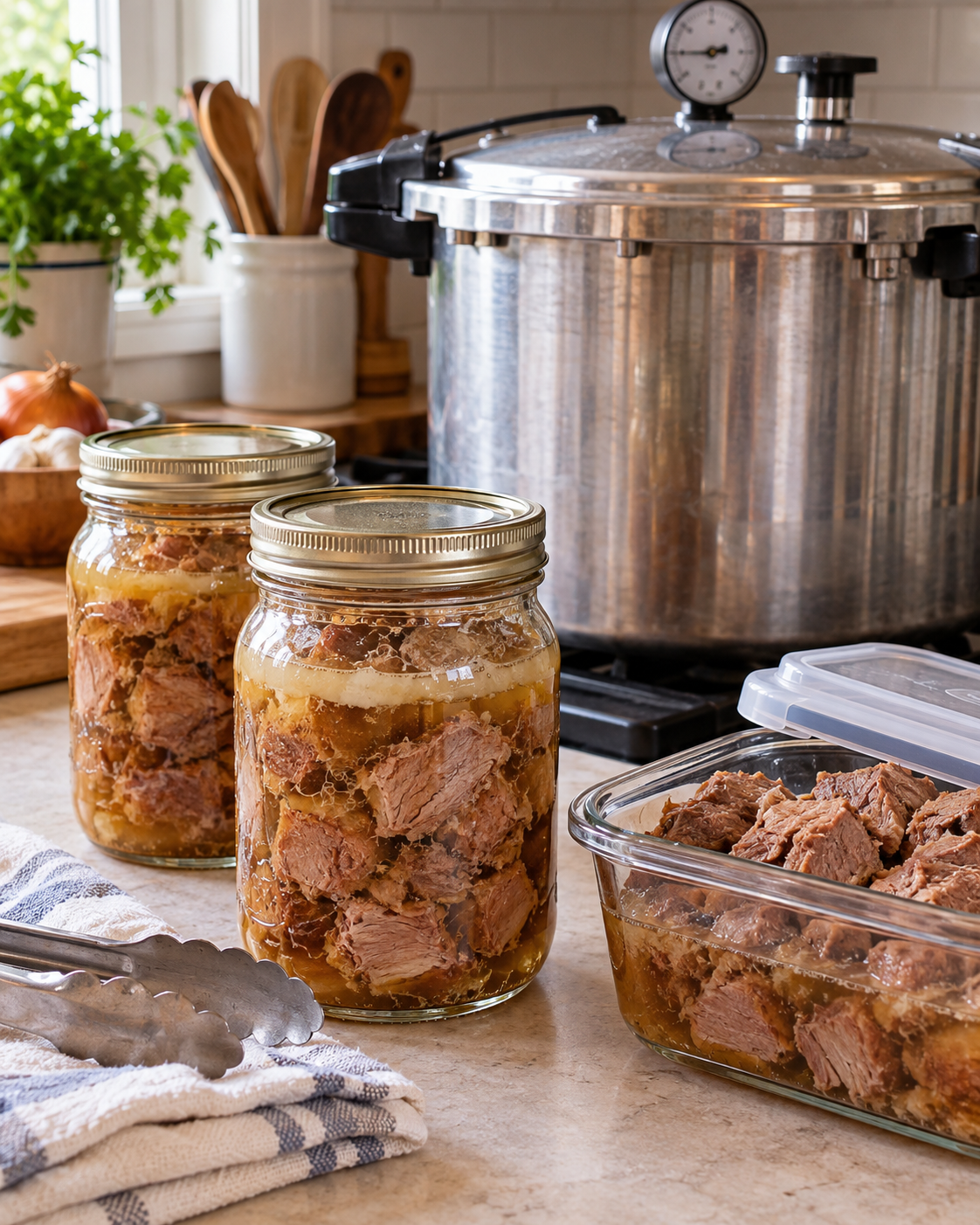
Home Canned Meat Safety Tips: Pressure Canning and Storage
Home canned meat safety is an important topic for anyone interested in preparing food ahead of time or preserving meat for future meals. While storing cooked meat in glass jars may seem convenient, there is a major difference between refrigerated meat and properly pressure-canned meat that can be stored unopened outside the refrigerator.
Meat is a low-acid food, which means that unsafe preservation methods can create conditions where dangerous bacteria produce toxins. A tightly sealed lid, a long cooking time, or a cool basement does not automatically make homemade meat safe for months.
The safest approach is to understand the different storage methods, choose the right equipment, and follow reliable food-preservation guidance.
These practical tips explain how pressure canning works, why ordinary boiling is unsuitable for shelf-stable meat, how to recognize storage mistakes, and when refrigeration or freezing is the better option.
Why Home Canned Meat Safety Matters
Improperly preserved meat can create a serious food-safety risk.
One particular concern is Clostridium botulinum, a bacterium that can form highly resistant spores.
Under certain conditions, those spores can grow and produce botulinum toxin, which causes botulism.
Botulism is uncommon but potentially life-threatening.
One reason the disease is especially concerning is that contaminated food may not have an unusual smell, taste, or appearance.
According to the Centers for Disease Control and Prevention (CDC), pressure canning is the only recommended home-canning method for low-acid foods such as meat, poultry, and seafood.
This makes choosing the correct preservation method essential.
1. Understand the Difference Between Refrigeration, Freezing, and Canning
Before storing prepared meat, decide whether you need short-term refrigeration, longer-term freezing, or genuinely shelf-stable preservation.
These methods serve different purposes.
Refrigerating Cooked Meat
Refrigeration is suitable for cooked meat that you plan to eat within a few days.
Store it in clean, covered containers at 40°F (4°C) or below.
Properly handled cooked meat leftovers generally keep for 3–4 days in the refrigerator.
Putting the meat into a glass jar does not extend that period automatically.
Freezing Cooked Meat
Freezing is useful when preparing larger quantities of cooked meat ahead of time.
Use appropriate freezer-safe containers and maintain the freezer at 0°F (-18°C) or below.
Frozen food can remain safe while continuously frozen at the proper temperature, although its quality may gradually decline.
Pressure Canning Meat
Pressure canning is a specialized preservation process used to make certain low-acid foods shelf-stable.
It requires suitable equipment and a scientifically tested method.
Only products processed correctly under those conditions should be considered for unopened pantry storage.
Important: A container of cooked meat is not automatically home-canned meat simply because the lid is sealed.
2. Use the Correct Equipment for Shelf-Stable Meat
One of the most important home canned meat safety tips is to use a suitable pressure canner.
A pressure canner is designed to achieve and maintain specific high-temperature processing conditions.
Those conditions are necessary when preserving low-acid foods.
Pressure Canner vs. Pressure Cooker
A pressure cooker is designed primarily for preparing meals.
A pressure canner is designed for processing jars of food according to validated home-canning procedures.
They are not automatically interchangeable.
A small pressure cooker may heat food quickly, but this does not mean its performance has been validated for preserving jars of meat.
What About Electric Multicookers?
Do not assume that an electric multicooker is safe for meat canning because it includes a pressure-cooking or canning setting.
CDC guidance advises against using electric multicooker appliances for low-acid home canning.
Use equipment specifically suitable for established USDA pressure-canning procedures.
Check Your Equipment
Before using a pressure canner, review the manufacturer’s instructions.
Important components include the pressure gauge or weighted regulator, vent pipe, lid, gasket, and safety mechanisms.
Make sure the equipment is in proper working condition.
For detailed guidance, consult the National Center for Home Food Preservation’s instructions on using pressure canners.
3. Never Use a Boiling-Water Bath for Ordinary Meat Canning
A boiling-water canner is suitable for certain high-acid foods when used with scientifically tested recipes.
However, ordinary meat is a low-acid food.
Boiling-water canning does not provide the same processing conditions required for low-acid meat products.
Unsafe Preservation Shortcuts
Do not attempt to make ordinary cooked meat shelf-stable by:
- Boiling filled jars in a regular pot.
- Heating meat-filled jars in an oven.
- Closing jars while the meat is hot.
- Using a microwave or dishwasher as a canning method.
- Relying on vacuum sealing alone.
- Repeatedly boiling jars without following a tested pressure-canning procedure.
These methods do not replace validated pressure canning.
Why a Tight Lid Isn’t Enough
When hot food cools inside a closed jar, a vacuum may develop.
The lid can appear firmly sealed.
However, a vacuum seal does not prove that the contents were processed adequately to control dangerous microorganisms.
This is why correctly checking a jar seal is only one part of a complete, tested canning procedure.
4. Always Follow a Scientifically Tested Canning Procedure
Safe pressure canning depends on the exact food and method being used.
A tested home-canning procedure specifies more than the ingredients.
It may identify:
- The type and preparation of meat.
- Suitable jar sizes.
- Whether the product uses a raw pack or hot pack.
- Required headspace.
- Processing time.
- Appropriate pressure.
- Adjustments for altitude.
- Venting and cooling requirements.
These details affect how heat moves through the food and whether the processing method is appropriate.
Don’t Change Important Processing Details
A recipe tested for plain meat chunks should not automatically be used for a thick meat stew.
Adding flour, cornstarch, cream, substantial additional fat, or different quantities of vegetables can change the way the food heats inside the jar.
Unless a validated procedure explicitly permits a modification, avoid making it.
Where to Find Reliable Methods
The National Center for Home Food Preservation publishes research-based instructions for meat prepared as strips, cubes, or chunks, as well as separate guidance for ground meat and other products.
Use those specific instructions rather than adapting an unrelated family recipe.
A familiar recipe may be delicious, but that alone does not make it suitable for shelf-stable canning.
5. Pay Attention to Altitude and Pressure
Pressure-canning recommendations change with elevation.
Atmospheric pressure affects the relationship between pressure and temperature.
For this reason, the required canner pressure can vary according to altitude.
Instructions may also differ between dial-gauge and weighted-gauge pressure canners.
Why You Shouldn’t Guess
Using a pressure setting that worked in another location may be inappropriate for your own kitchen.
Always confirm the altitude requirements in the tested procedure.
Use the recommendations for your specific equipment and food.
If you cannot verify the correct processing method, refrigerating or freezing the meat is a safer choice than improvising.
6. Understand the Importance of Proper Cooling and Sealing
After a valid pressure-canning process, jars must cool according to established instructions.
Pressure canners should be allowed to depressurize naturally.
Do not force-cool the canner under running water or attempt to open it while pressure remains inside.
Once the canner has depressurized, follow the tested instructions for removing and cooling the jars.
Check the Seal at the Correct Time
For commonly used two-piece canning lids, the National Center for Home Food Preservation recommends allowing jars to cool undisturbed for approximately 12–24 hours before checking the seals.
Inspect the jars and lids for damage.
Follow official instructions for dealing with jars that fail to seal.
A Successful Seal Doesn’t Correct Unsafe Processing
This point is essential.
A jar can appear properly sealed even when its contents were not processed safely.
Never use the seal alone to decide whether homemade canned meat is safe.
7. Store Properly Canned Meat in a Cool, Dry Place
After meat has undergone a validated pressure-canning process and the jar seals have been checked correctly, storage conditions become important.
Properly canned food should be stored in a clean, cool, dark, and dry location.
For best quality, the National Center for Home Food Preservation recommends storage temperatures of approximately 50–70°F (10–21°C).
Avoid Poor Storage Conditions
Do not store home-canned food:
- In direct sunlight.
- Near ovens or heating appliances.
- In locations exposed to excessive heat.
- In damp areas that may damage lids or containers.
- Where jars may be knocked over or broken.
Label Your Jars
Mark each jar with the food name and the date of processing.
This makes it easier to identify stored products and use older batches first.
For best quality, official home-canning guidance generally recommends planning to use properly canned foods within one year.
That recommendation applies only to food that was safely processed in the first place.
8. Don’t Assume a Basement Is Safe for Every Jar
A cool basement may seem like a good place to store homemade preserved meat.
However, storage temperature is only one part of food safety.
Ordinary cooked meat stored in jars without validated pressure canning remains perishable.
It must be refrigerated or frozen.
When Is Pantry Storage Appropriate?
Unopened shelf storage is appropriate only for products processed using a scientifically tested shelf-stable preservation method and stored under suitable conditions.
When Is Refrigeration Required?
Refrigeration is required when the meat has simply been cooked and transferred into food-safe containers without a valid shelf-stable canning process.
Closing the lid does not change this requirement.
Practical tip: If you aren’t certain whether a jar of homemade meat was pressure-canned correctly, don’t assume it’s safe because it has been stored in a cool place.
9. Use Refrigeration and Freezing When Pressure Canning Isn’t Available
You don’t need to preserve meat in shelf-stable jars to prepare food for future meals.
Refrigeration and freezing are practical alternatives.
Refrigeration Tips
After cooking meat completely:
- Divide large portions into smaller quantities.
- Use clean, shallow, food-safe containers.
- Refrigerate promptly.
- Keep the refrigerator at 40°F (4°C) or below.
- Use properly refrigerated cooked meat leftovers within 3–4 days.
Do not leave large containers of cooked meat on the kitchen counter for several hours while waiting for them to cool.
Freezing Tips
For longer storage:
- Choose freezer-safe containers or bags.
- Divide meat into meal-sized portions.
- Remove excess air when practical.
- Label containers with the preparation date.
- Maintain a freezer temperature of 0°F (-18°C) or below.
For many cooked meat leftovers, FoodSafety.gov lists approximately 2–6 months as a recommended freezer period for quality.
The exact quality period varies by preparation.
Using Glass Jars in the Freezer
Only use glass containers designed for freezing.
Follow the manufacturer’s instructions, including any required expansion space.
Ordinary glass jars may crack as their contents freeze.
10. Cool, Thaw, and Reheat Meat Safely
Safe storage also depends on what happens before and after refrigeration or freezing.
Cool Cooked Meat Promptly
Refrigerate perishable cooked food within two hours.
If the surrounding temperature exceeds 90°F (32°C), reduce the limit to one hour.
Smaller, shallow containers help food cool more quickly.
Thaw Frozen Meat Safely
Use recognized thawing methods, such as:
- Thawing in the refrigerator.
- Thawing in cold water with suitable leakproof packaging and frequent water changes.
- Microwave thawing followed by immediate cooking or reheating, as appropriate.
Avoid leaving frozen meat to thaw overnight on the countertop.
Reheat Leftovers Thoroughly
Reheat cooked meat leftovers to 165°F (74°C).
Use a food thermometer when practical.
However, reheating should never be considered a way to rescue improperly canned meat or food suspected of containing botulinum toxin.
If the preservation method was unsafe or unknown, do not taste the product.
11. Recognize Warning Signs of Unsafe Canned Food
Inspect homemade preserved foods before using them.
Some visible problems can indicate contamination or damage.
Warning signs include:
- Bulging or leaking lids.
- Cracked or damaged jars.
- Liquid or foam spurting when a container is opened.
- Mold growth.
- Unusual discoloration.
- Unexpected gas or swelling.
If a jar shows these problems, do not eat its contents.
Remember That Dangerous Food May Look Normal
Not every unsafe preserved product shows visible spoilage.
Botulinum toxin cannot reliably be detected by smell, appearance, or taste.
Never sample questionable canned food to decide whether it is safe.
If the processing history is uncertain, follow official guidance for handling and disposing of potentially contaminated jars.
Why These Meat Storage Tips Work
The recommendations above are based on established food-preservation principles.
Meat Has Low Acidity
Low-acid foods can support the growth of certain dangerous microorganisms when preserved improperly.
This is one reason meat requires special pressure-canning procedures for shelf storage.
Validated Processing Controls Dangerous Spores
Research-tested pressure-canning methods account for the food’s heating characteristics and the conditions needed for safe preservation.
Refrigeration Slows Microbial Growth
Keeping cooked meat cold helps slow the growth of many harmful microorganisms.
It does not make food that has already been stored unsafely safe again.
Freezing Extends Storage Possibilities
Freezing prevents microbial growth while the food remains continuously frozen at an appropriate temperature.
However, it does not reliably destroy all microorganisms.
Clean Containers Protect Food Quality
Suitable containers help reduce contamination and protect food during storage.
They do not replace proper processing or temperature control.
Common Mistakes to Avoid
Mistake 1: Assuming Every Sealed Jar Is Shelf-Stable
A vacuum seal is not proof of correct pressure processing.
Better approach: Use a validated canning method and follow all processing and seal-checking instructions.
Mistake 2: Using a Regular Pressure Cooker
Not every pressure cooker is suitable for home canning.
Better approach: Use equipment appropriate for established USDA pressure-canning procedures.
Mistake 3: Changing a Tested Recipe
Adding ingredients or changing jar sizes may affect processing requirements.
Better approach: Follow the tested formulation and instructions without unsupported modifications.
Mistake 4: Storing Refrigerated Meat in a Cellar
A cellar is not a substitute for a properly functioning refrigerator.
Better approach: Refrigerate or freeze cooked meat that has not been safely pressure-canned.
Mistake 5: Letting Cooked Meat Cool for Too Long
Large containers can retain heat for extended periods.
Better approach: Divide meat into shallow containers and refrigerate promptly.
Mistake 6: Trusting Smell and Appearance Alone
Some dangerous contaminants produce no obvious sensory warning signs.
Better approach: Follow proper preservation methods and never taste suspicious canned food.
Practical Examples
Preparing Cooked Meat for the Week
If you cook a large batch of beef or chicken, separate it into smaller portions.
Refrigerate what you plan to use within the recommended period.
Freeze the remaining portions promptly.
This is a practical meal-preparation approach, not shelf-stable canning.
Storing Meat for Several Months
If you want meat that can be stored unopened outside the refrigerator, use a suitable pressure canner and a validated procedure for the specific food.
Do not adapt an ordinary cooked-meat recipe simply by placing it in jars.
Finding an Old Jar of Homemade Meat
If a jar was prepared by someone else and you cannot verify how it was processed, do not assume it is safe.
A sealed lid and normal-looking contents are not enough to establish safety.
Do not taste the food.
Frequently Asked Questions
Can You Preserve Meat in Glass Jars at Home?
Yes, but shelf-stable meat preservation requires an appropriate pressure canner and scientifically tested processing instructions.
Is Boiling Meat in Jars Enough for Long-Term Storage?
No. Ordinary boiling-water canning is not recommended for low-acid meat.
Can I Use an Electric Pressure Cooker to Can Meat?
Do not assume an electric pressure cooker or multicooker is suitable for home canning. Follow official equipment recommendations.
Does Vacuum Sealing Make Cooked Meat Shelf-Stable?
No. Vacuum sealing does not replace a validated preservation process.
Can Cooked Meat Be Stored in Glass Jars in the Refrigerator?
Yes. Clean, food-safe glass containers can be used for refrigerated cooked meat.
Follow normal refrigeration temperatures and storage limits.
How Long Does Refrigerated Cooked Meat Last?
Properly refrigerated cooked meat leftovers generally keep for 3–4 days at 40°F (4°C) or below.
Can I Freeze Cooked Meat Instead of Canning It?
Yes. Freezing is a practical alternative when you do not have suitable pressure-canning equipment.
Does Adding Salt Make Meat Safe for Pantry Storage?
No. Adding ordinary amounts of salt does not replace validated pressure canning.
Can Homemade Canned Meat Be Kept in a Basement?
Only correctly processed, shelf-stable products should be considered for appropriate pantry or cellar storage.
Ordinary cooked meat in sealed containers still requires refrigeration or freezing.
How Long Does Properly Canned Meat Last?
For the best quality, official home-canning guidance generally recommends planning to use properly canned food within one year.
This is not a guarantee that improperly processed meat becomes safe.
Can You Detect Botulism by Smell?
No. Botulinum toxin cannot reliably be detected by smell, taste, or appearance.
What Should I Do If I Suspect a Jar Is Unsafe?
Do not taste it or attempt to rescue it by reheating.
Follow official CDC or USDA guidance for handling and disposing of potentially contaminated home-canned foods.
More Food Safety Tips from DailyDishCraft
Food storage safety is useful far beyond home canning.
Our guide, 4 Simple Steps to Food Safety: Clean, Separate, Cook, and Chill, explains how to handle ingredients, prevent cross-contamination, check cooking temperatures, and refrigerate food correctly.
Our Homemade Pasta Sauce Tips article also discusses the differences between freezing and safe home preservation for prepared sauces.
These resources can help you apply better food-handling practices to everyday cooking.
Final Thoughts
Home canned meat safety depends on using an appropriate preservation method from the beginning.
For shelf-stable meat, follow a scientifically tested pressure-canning procedure with suitable equipment, correct processing conditions, and proper storage practices.
If you do not have a suitable pressure canner, refrigeration and freezing are practical alternatives.
Never assume that a tightly sealed jar, a long boiling time, or a cool basement makes ordinary cooked meat safe for months.
By understanding the differences between refrigeration, freezing, and pressure canning, you can make better-informed choices about storing meat at home.
Official Food Safety References
CDC — Home-Canned Foods and Botulism Prevention
https://www.cdc.gov/botulism/prevention/home-canned-foods.html
National Center for Home Food Preservation — Meat, Strips, Cubes or Chunks
National Center for Home Food Preservation — Using Pressure Canners
https://nchfp.uga.edu/how/can/general-information/using-pressure-canners/
National Center for Home Food Preservation — Storing Home-Canned Foods
https://nchfp.uga.edu/how/can/general-information/storing-home-canned-foods/
FoodSafety.gov — Cold Food Storage Chart
https://www.foodsafety.gov/food-safety-charts/cold-food-storage-charts